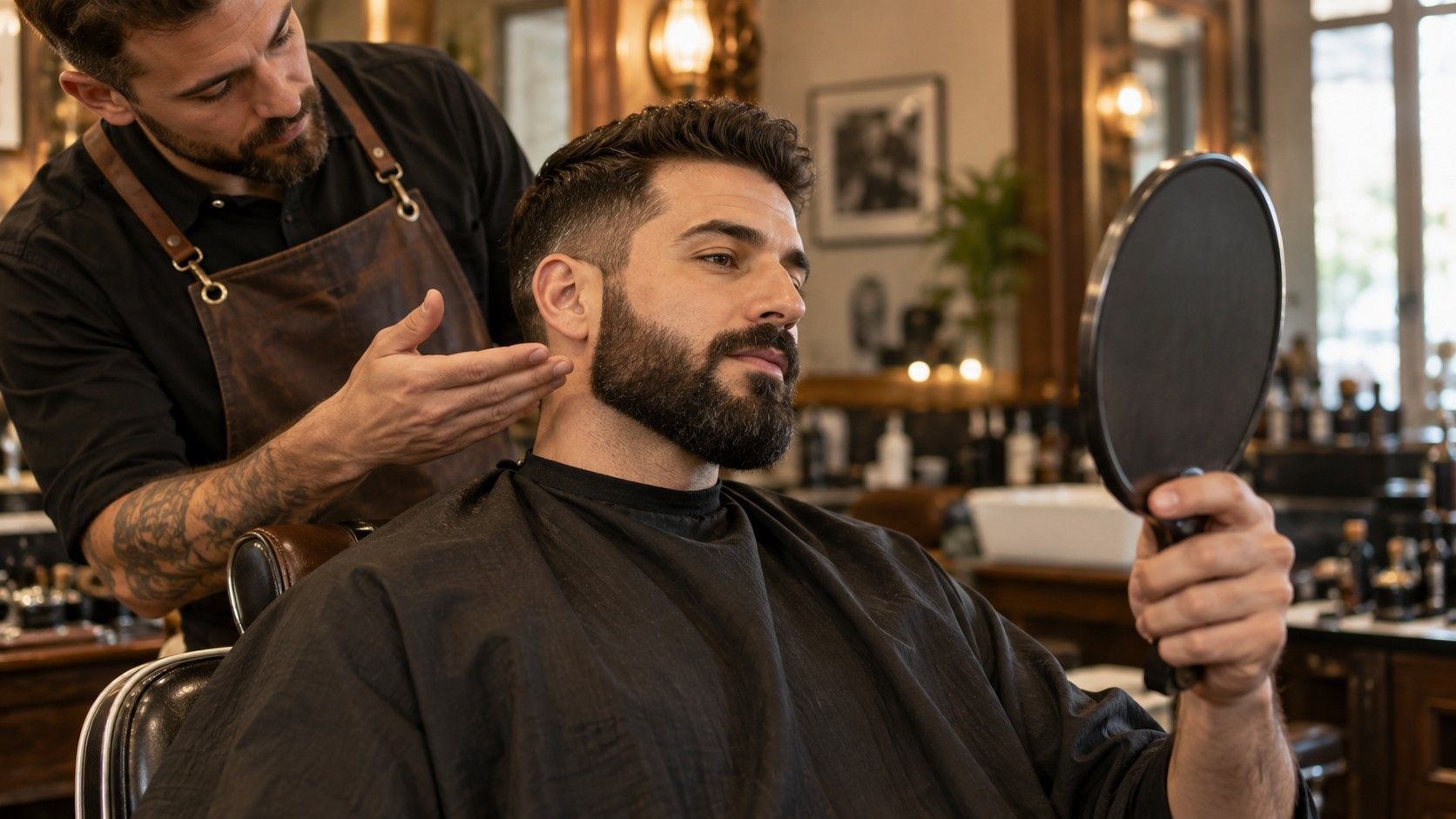
A beard changes the outline you see in the mirror, sometimes enough to make a familiar face look longer, wider or more angular. That does not mean you need to disguise the shape underneath. When comparing beard styles for face shape, start with the growth you have and decide which lines you enjoy. The useful choices are concrete: how much length to keep at the chin, how full the sides should look, and how much edge work you want to maintain between trims.
Look at the face and the beard as separate outlines
Use a level mirror with your head in its usual position. Look at the visible forehead and cheek area, then follow the lower outline. Notice where skin stops being the boundary and hair takes over. A broad beard can create a wide lower face; extra hair beneath the chin can extend its apparent length. Neither tells you exactly what the hidden jaw would look like without it.
If you have an older clean-shaven photo, it may help you describe the underlying proportions, but you do not need to shave to choose a new style. Work with what you can see. You might note curved cheeks above a fairly straight beard edge, or a narrow upper face above full sides. Those descriptions already identify where a grooming change would have the most visible effect.
Take a front view and a side view in even light if you want a reference. Keep the camera farther away than a close selfie and crop afterward. Do not lift the chin to expose the neckline in the main comparison: that position changes how the lower beard hangs. Check the neckline separately, then return to a relaxed posture to judge the outline you actually wear.
Compare growth at the sides and chin before choosing a picture
Brush or comb the beard into the way you normally wear it and look at its distribution. Is the chin fuller than the cheeks? Do the sideburns connect clearly, or does one area look more open? Does the hair curl back toward the face or stand away from it? A reference style built around dense sides may need adapting when most of your visible fullness is concentrated at the chin.
Apparent density changes with hair direction, color contrast and length. Inspect your beard in ordinary daylight as well as the bathroom mirror, without treating the most unforgiving light as the only truthful view. You are looking for a shape that works with your existing growth.
Bring the reference image to a barber and identify the detail you want: a shorter side, a broad bottom edge, a rounded corner or a little more chin length. Ask which parts your current growth can support and what would need a different approach. A named beard style can cover quite different versions, while pointing to a particular line makes the conversation much clearer.
Choose where to keep length instead of following a shape chart
Extra length below the chin can make the visible lower outline feel longer. Fullness at the sides can make it feel wider. These effects are useful to consider, but they are not obligations. If you have a long-looking face and enjoy a long beard, you do not need to shorten it simply because a chart recommends width. Decide which overall proportion you like and how much maintenance you accept.
For less width, discuss reducing side fullness gradually. To keep more length below the chin, leave that area longer and check the side view before taking more off. If you prefer a rounder bottom, soften the corners rather than shortening the entire beard. A clearer lower edge is a different choice again: it changes the line and asks for regular tidying. Each adjustment should work within the growth already there.
The same trimmer setting can produce different appearances in different areas because the hair does not all lie the same way. A setting is a useful record, not a promise of an identical outline. If you trim at home, follow the tool instructions and remove less than you think you need at first. You can reassess after combing the hair back into place.
Change one area, then stop and check the whole face. Taking the sides shorter, raising the cheek line and shortening the chin in one session makes it hard to see which adjustment helped. A gradual approach also leaves more room for a barber to refine the result. There is no advantage in chasing a reference photograph so closely that you remove the length needed for your preferred shape.
Set a cheek line and neckline you can maintain
The cheek line is the upper boundary of the visible beard. A softer edge can follow the existing growth with less frequent tidying; a sharply defined edge generally asks for more regular attention. Compare the two effects in reference images and then look at your own growth. A line drawn above an area with little hair cannot be reproduced simply by shaving a crisp boundary elsewhere.
Be cautious about moving the cheek line lower to make both sides appear identical. Removing hair from the fuller side may leave less coverage than you wanted. Small differences between the two sides do not require correction every time you look in the mirror. Decide how clean you want the edge to appear at an ordinary conversational distance, then ask a barber how to maintain that result.
The neckline needs checking from the front and side with your head relaxed. A line that looks tidy only when the chin is lifted may look different as soon as you return to normal posture. There is no single position that suits every beard length and growth pattern. For a first substantial reshape, have a barber show you the intended boundary before removing hair.
Ask for the maintenance line to be shown to you clearly in the mirror. It helps to know which stray hairs to tidy and which area should be left to grow. If you find yourself repeatedly moving an edge higher while trying to make it cleaner, pause. A slightly less exact line is easier to review than a series of small corrections that changes the entire beard.
Judge the result in your everyday routine
A freshly combed beard under shop lighting is one useful view. Your regular routine is another. Check the result after washing and drying it in your usual way, and notice what happens when you wear a collar, scarf or jacket. A shape that looks compact in front may project more from the side, while a longer lower section may sit differently against clothing.
Keep your hairstyle in the comparison. Full sideburns can connect the beard visually to the hair above them; closely cut sides can create a clearer separation. If you are changing both hair and beard, tell the barber which part you want to remain fuller. Otherwise two individually reasonable decisions can produce a combined outline you did not intend.
You may want a quieter edge during a busy week and a more defined one for an occasion. That is a maintenance preference, not a different face shape. Be honest about how often you want to trim and whether you enjoy detailed edge work. The most elaborate reference is not automatically the most useful choice for someone who wants to comb the beard and leave the house.
Use photographs to record the result if that helps, but keep the angle and light similar. Compare a front view with another front view, rather than a close smiling selfie with a distant side portrait. Also pay attention to comfort and ease of grooming. A beard you like in motion and can maintain is more valuable than one flattering image that takes a long time to recreate.
Give the barber a request that can be checked
Before the trim, describe what you want to keep as clearly as what you want reduced. For example: keep the chin length, reduce the fullness near the lower sides, preserve the current cheek coverage and soften the bottom corners. Ask the barber to confirm the intended outline in the mirror. This gives both of you a shared reference before a large amount of hair is removed.
If you are unsure about the final length, request a conservative first pass and reassess. Explain which view bothers you: the width from the front, the projection from the side or the way the edge meets your haircut. “Make it suit my face” leaves much more room for interpretation. Specific observations make it easier to agree on a result without relying on a disputed shape label.
Afterward, keep a short note of the approach and any tool settings the barber recommends for maintenance. Add a front and side photo if you like. Note what became easier and what you would change next time. That record is a practical beard face shape reference based on your own preferences, rather than a list of styles assigned to a geometric category.
You can stop experimenting when the outline feels right for your routine. A curved jaw can wear a rounded beard; a broad jaw can remain visible; a longer face can carry more chin length if that is the effect you enjoy. Face shape helps explain the visual choices available. It does not supply a standard you must trim yourself toward.